Hot Tapping Houston & Texas & More
Hot Tapping & TS&V Services for Municipal and Commercial Water Mains
Hot tapping, also called wet tapping, water tapping, or pressure tapping, is a method for cutting a new branch connection into a live water main without shutting off service.
The equipment behind it is called TS&V (tapping sleeve and valve), and it's what makes a water main tap possible without draining or depressurizing the line. We stock a full range of tapping sleeves and valves, run our own tapping machines, and staff the crew that carries the job from setup through completion.
Municipalities, general contractors, and mechanical subs call us for municipal hot tapping and commercial hot tapping work when taking a main out of service isn't an option. Request a quote, and we'll get a crew and the right sleeve and valve combination scheduled for your project.
What Hot Tapping Involves
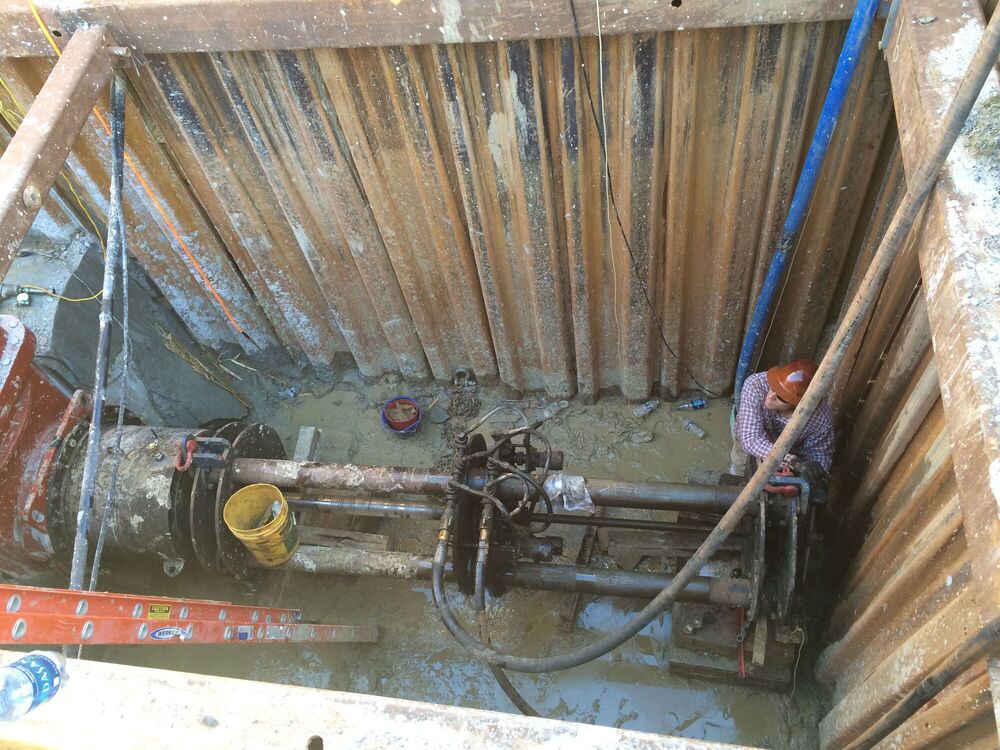
The sleeve and valve assembly seals around the pipe before any cut is made, so the main stays pressurized and in service throughout. The only thing that changes is a new connection point. Here's how a standard tap runs, start to finish:
- Inspection: We expose and brace the section of the main where the tap will go, then confirm pipe material, diameter, and condition against the job spec before any equipment is put on.
- Setup: We install the tapping sleeve around the main and bolt the valve to the sleeve, pressure-testing the assembly before cutting starts.
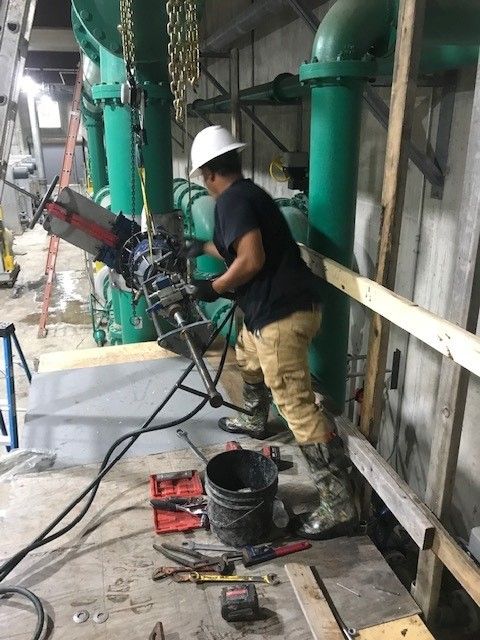
- Tapping: A tapping machine mounted on the valve drives the correct cutter head through the pipe wall while the main stays live and under pressure.
- Completion: We retract the cutter, leaving the cutout section attached, close the valve to seal the new connection, and remove the machine. The main is in service the entire time.
Hot Tapping vs. a Cut-In Tee
The traditional alternative to hot tapping is cutting in a tee: shutting down the main, draining the affected section, cutting the pipe, and welding or fitting in a tee before bringing the line back into service. Hot tapping skips the shutdown. For a municipal or commercial system, where an outage means a public notice, a temporary water source, or a shut-valve list that reaches more customers than the job itself, that difference usually determines which method is specified.
- Water loss: a cut-in tee requires draining the section being worked on; a hot tap loses none.
- Contamination risk: an open, drained pipe has to be flushed and disinfected before it goes back in service; a hot tap keeps the main sealed throughout.
- Scheduling: a cut-in tee needs a planned outage window, often overnight or on a set notice period; a hot tap runs on a normal working schedule.
- Crew time: a cut-in tee adds draining, cutting, fitting, refilling, and disinfection steps; a hot tap is one continuous procedure.
TS&V Inventory and Capabilities
A tap only moves as fast as the sleeve and valve on hand. Underground pipe doesn't always match the drawings, and ordering the wrong sleeve after a crew is already on site adds days to a job.
We keep tapping sleeves and valves in stock rather than special-ordering them once a job is scoped, including epoxy-coated steel, stainless steel, and mechanical joint (MJ) tapping sleeves, sized for taps from 1/2 inch to 48 inches. That inventory is a big part of how we hold to same-day and next-day scheduling on standard taps: our crews aren't waiting on a special order before the job can start.
Pipe Materials and Contents
The sleeve and valve have to match the pipe, and pipe underground varies by decade and by system. We tap PVC/C900, ductile iron, cast iron, asbestos cement, steel, Gifford-Hill concrete cylinder pipe, and HDPE, carrying water, sanitary sewer, storm sewer, steam, air, and natural gas.
Concrete cylinder pipe shows up often enough in older municipal systems that we run it as its own service rather than treating it as an exception.
Steam, air, and natural gas lines come up less often than water and sewer, but the same live-tap process applies without an outage on those systems, too. Operating limits for a standard tap run up to 600 psi and 400°F, which cover the vast majority of municipal and commercial water main work.
Pipe Diameter Range
Tap sizes range from 1/2 inch to 48 inches, covering everything from a small commercial water main tap to a large-diameter municipal main tap.
That range matters because a fitting or crew sized for a small service tap isn't equipped for a 36-inch transmission main. And the reverse is just as true: oversized equipment on a small service line slows down a job that should be routine and raises the odds of a mistake.
| 3/4 inch | 16 inch | 36 inch |
| 2 inch | 20 inch | 40 inch |
| 4 inch | 24 inch | 44 inch |
| 8 inch | 28 inch | 48 inch |
| 12 inch | 32 inch |
Hot Tapping Service Area
Our municipal and commercial hot tapping crews run across Houston-area cities, including Bellaire, West University, Jersey Village, Katy, Rosenberg, Pearland, Friendswood, League City, Baytown, and Shenandoah, with same-day or next-day scheduling guaranteed on standard taps.
Larger-diameter taps and jobs outside the immediate Houston area are scheduled on a case-by-case basis; see our Texas service page for coverage across the rest of the state - please contact us and we will work with you to determine if our solutions are right for your work.
What Working With Mickie Looks Like
Hot tapping on a live main depends on everything being lined up before a crew arrives on site, from the sleeve and valve already sitting in inventory to the documentation your team gets once a job wraps. That's what you get from a hot-tapping contractor that stocks its own equipment and staffs its own crews:
- Same-day or next-day service guarantee on standard-sized taps
- Large on-hand inventory of tapping sleeves and valves
- Full-time project manager and office staff managing all service aspects
- Extensive knowledge of local specs and long-standing inspector relationships
- Highly trained, experienced installation technicians
- Real-time job checklists generated and provided to customers
Commercial and Municipal Hot Tapping
Guarantees no service disruption or water loss.
Reduces scheduling variability (no need to coordinate with the authorities on water main shutdown, which can often take multiple attempts).
Eliminates the risk of water main contamination
Reduces crew service time and off-peak hours scheduling.
Saves time and costs, from start to finish.
There are several names for hot tapping that you might have seen including:
- Pressure tapping
- Industrial TS&V services
- Wet tap
- Water tapping
We are able to work with operating pressures up to 600 psi and temperatures up to 400 degrees Fahrenheit. Mickie Services performs hot tapping on the following main water pipe materials:
- PVC / C900
- Ductile Iron
- Cast Iron
- Asbestos Cement (AC)
- Steel
- Gifford-Hill Concrete (link to Concrete Steel Cylinder Tap)
- HDPE
- Tap size: 1/2"-48"
- Pipe Contents
- Water
- Sanitary Sewer
- Storm Sewer
- Steam
- Air
- Natural Gas
Ready To Start Your Project?
Leveraging our core capabilities in water main tapping – we now provide line stops, insertion valves, and private fire line installation.
Frequently Asked Questions About Hot Tapping & TS&V Services
Is a permit required for a hot tap?
Permit requirements depend on the city or utility district the main belongs to. We coordinate with your engineer or inspector on the technical specs for the tap itself, and we also offer permitting services separately if you need help managing that process.
What if my pipe material isn't on your list?
The materials above cover most of what we see in the field, but conditions vary by system and by decade. If you're not sure your main matches one of them, tell us the details when you request a quote, and we'll confirm it's a fit before scheduling a crew.
Can I request a tap directly, or does it need to come through my utility or engineer?
Either one. We take requests directly from general contractors, mechanical subs, and property owners, as well as from municipal engineers and utility staff. Whoever is managing the project can request the quote, and we'll coordinate with your engineer or inspector on the specs from there.
Line Stops, Insertion Valves, and Fire Line Installation
Hot tapping isn't the only way to work on a live water main.
If a repair needs to isolate a section of pipe rather than add a permanent branch, our line-stopping service inserts a temporary plug so that the section can be worked on while the rest of the system stays in service. Where the goal is a permanent valve added to an existing main rather than a temporary isolation, our insertion valve service handles that instead.
We also install fire lines under the same live-line approach. If your project needs more than a single tap, talk to us about the full scope before you request a quote.


